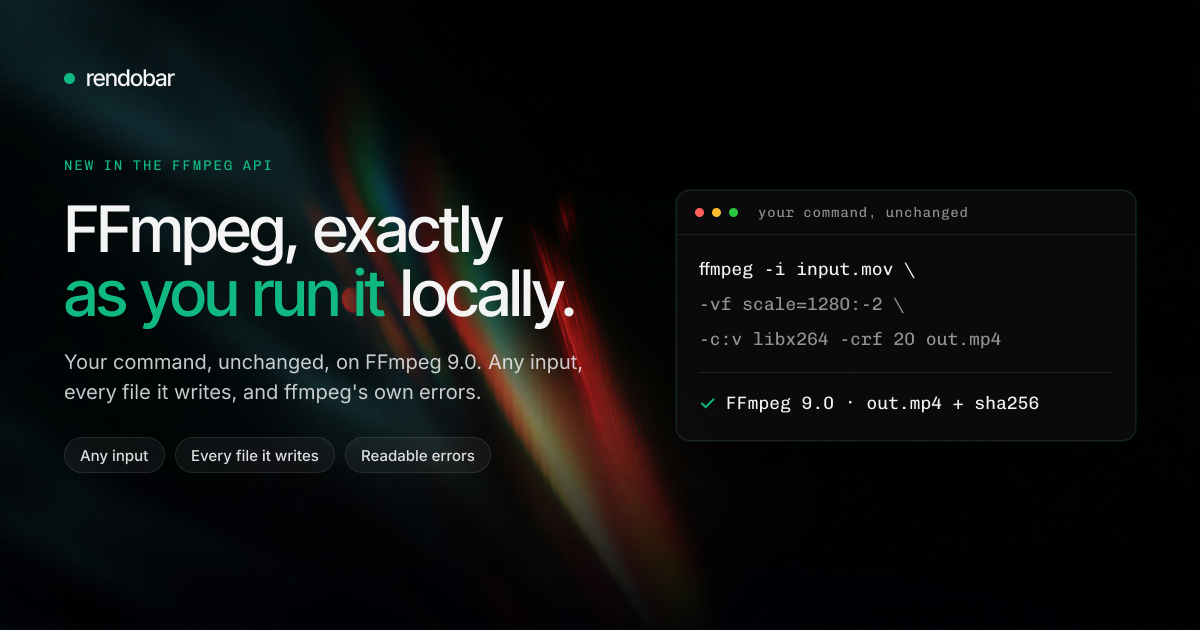
FFmpeg 9 in the cloud, run it exactly as local
Run FFmpeg 9.0 through one API call. Send the command you would run locally, pass any input, and get back every file it writes, with no server to manage.

The Rendobar Blog
Engineering deep dives and developer guides on processing video at scale. How the Rendobar API works under the hood, FFmpeg techniques you can run today, and the stack that keeps it fast.

Run FFmpeg 9.0 through one API call. Send the command you would run locally, pass any input, and get back every file it writes, with no server to manage.
Compare Rendobar and Creatomate for JSON video: per-second billing against pixel credits, about $1 a minute of 1080p on Essential, and one edit in both formats.
Compare what 7 JSON video APIs charge for 10, 100 and 1,000 minutes of video a month, from pay as you go to annual plans. Prices checked 2026-10-20.
Compare Rendobar and JSON2Video for JSON video: $0.04 a minute against 20 to 42 cents, scenes against tracks, and free renders that carry no watermark.
Compare Rendobar and Shotstack for JSON video: $0.04 a minute against 20 cents pay as you go, feature by feature, and the same edit written in both formats.
Caption a video with animated word-by-word styles in one API call. See three presets on one clip, the FFmpeg ASS karaoke route, and where it breaks.
Get a video under Discord's 20 MB free upload limit with the two-pass bitrate formula, see why one CRF guess misses, and cap the size in one API call.
Get a vertical phone video under WhatsApp's 16 MB media limit as H.264 and AAC, keep it 9:16, and meet the Business API's stricter codec rules.
Compare self-hosted FFmpeg, a template API and an FFmpeg API that also runs timelines, on one real edit with measured render time and cost per run.
Render an 18 second 1080p MP4 from one JSON timeline with a crossfade, titles and music, and see the FFmpeg filter graph the same edit needs.
Learn how the FFmpeg benchmarks on this blog are run: the source clip, what stays fixed, why sizes are exact and timings are not, and how to rerun a sweep.
Compare 13 video processing APIs on delivering output to a bucket you own. Three can write to S3 through an IAM role, and five document no delivery at all.
Send job outputs to your S3 bucket through an IAM role a service assumes, with no access key to leak and access revoked by deleting one stack.
Run FFmpeg, compression and captions on n8n Cloud with the verified Rendobar node, installed from the nodes panel, with long jobs parked on a Wait node.
Learn why an S3 presigned URL dies before its expiry when a role session signed it, and why the failure arrives as a 400 ExpiredToken, not a 403.
Generate a thumbnail for every video that lands in S3 without the black first frame. Seek in, size the JPEG for its slot, and key each job on the ETag.
Process video in S3 with FFmpeg by reading a presigned URL and piping the result back, then see what changes when an encode outlives Lambda's 900 seconds.
Send FFmpeg output to an S3 bucket by piping a fragmented MP4 into aws s3 cp. A regular MP4 can't stream, and MPEG-TS cost 7.5% more bytes.
Add the Rendobar piece to Activepieces, connect an API key, and build a flow that compresses a video and posts the link while the flow sleeps.
Learn why a video API renders the wrong font without an error, how a CSS font stack fixes it, and which of 16 writing systems render with no setup.
Compare what Opus, AAC, MP3 and FLAC deliver against the bitrate you ask for. Opus at 64k wrote 29 percent more bytes than requested, AAC within 3 percent.
Compare H.264, HEVC and AV1 held to one 150 KB budget and scored with VMAF. At about 245 kbps for a 720p clip, AV1 scored 84.8, HEVC 76.2 and H.264 64.3.
Compare H.264, HEVC, VP9 and two AV1 encoders at their usual CRF on one clip, by size, encode time and cost, and see why the AV1 encoder mattered.
Compare AVIF, WebP, JPEG and PNG encoded from one frame at each format's usual quality setting. AVIF wrote the smallest file, with quality left unmatched.
Convert a file size target into FFmpeg settings with the two-pass formula or a CRF search, and see how little already-encoded video shrinks.
See how a compression job spots that re-encoding would grow an efficient file and returns the original, and how it reports a size target it cannot reach.
Compare CRF, target bitrate and VBV-capped modes in FFmpeg on one clip. Single-pass 700k ABR overshot by 13%, and adding a VBV cap landed within 0.2% of target.
Compare what 6 FFmpeg APIs charge for one stated workload of 400 short clips a month, then watch the ranking flip on large files. Prices checked 2026-09-26.
Render SRT or ASS captions into the picture with FFmpeg, with the escaping a subtitles= path or URL needs, force_style keys, and when to keep them soft.
Compare FFmpeg CRF 18 to 32 on one clip. Each 3 points of CRF removed about a quarter of the file, while encode time showed no pattern at all.
Compare the FFmpeg settings that change output size, measured on one file: preset, keyframe interval, CRF, tune, scaler and pixel format, ranked by effect.
Find the fix for common FFmpeg errors, from moov atom not found to Invalid argument, and learn why most failed video jobs never reached FFmpeg.
Compare FFmpeg keyframe intervals on one clip: what a shorter GOP adds to the file, what it buys, and the flags that give HLS segments aligned keyframes.
Compare FFmpeg scaling flags on one 720p to 480p downscale. The flag moved output size by 66 percent and encode time by nothing measurable.
Compare FFmpeg libx264 thread counts from 1 to 8 over five runs each. Eight threads was 2.99x faster than one, and pinned threads made the timings repeatable.
Compare all seven x264 -tune values on one clip at CRF 23. zerolatency needed 2.2x the bytes and fastdecode 1.7x. On a capped stream they cost quality.
Watermark a video with FFmpeg using an image or text, with corner positions, logo sizing relative to the frame, and why overlay under -vf always fails.
Probe a media file with the five ffprobe commands that cover most jobs, each shown with the output ffprobe 8.0 prints, from one field to the full JSON.
Probe an uploaded file to confirm it is real media before you encode it, with four checks, a local Node validator and the error a renamed file returns.
Read a video duration with ffprobe when the container and streams disagree. On MP4s with audio the container matched the audio, up to 493 ms past the video.
Compare 6 free FFmpeg API tiers by what they let you run before paying: runtime caps, input size caps, card checks and trimmed output. Checked 2026-09-26.
Learn why one FFmpeg command gave byte-identical output ten times while its encode time swung 2.13x, and how pinning -threads makes the timings repeatable.
Build an n8n AI Agent that runs FFmpeg jobs as tools, checks its balance before it spends, and reads the real FFmpeg error when a job fails.
Compare NVENC on an NVIDIA L4 against libx264 on one clip. h264_nvenc cost 1.3x to 2.2x less per job and wrote 2.2x the bytes, and speed was inside the noise.
Compare SVT-AV1 presets 4 to 12 over three runs each. Preset 4 took 3.9x as long as preset 12 for a file a fifth smaller, at quality this sweep did not score.
Compare the cost of each rung in a 1080p to 240p transcode ladder. On a 720p source the 1080p rung took 4x the encode time of 720p and added no detail.
Compare AV1, HEVC, VP9 and H.264 on one file. Held to one 150 KB budget, AV1 scored VMAF 84.8 against H.264's 64.3. Encode time and cost per codec too.
Compare the 4 kinds of video processing API, raw FFmpeg, timeline, video platform and batch transcoder, by what you send and how each one bills.
Read where the time goes when a short clip is transcoded through a video API. Waiting to start took a median 3.6 s, over four times the FFmpeg encode.
Compare all nine x264 presets at CRF 23 on one clip. ultrafast wrote 6.6x the bytes of veryslow, and the middle presets do not shrink in order of effort.
Compare FFmpeg pixel formats on one clip, check why a video fails in QuickTime or Safari, and fix it with one flag. yuv420p also wrote the smallest file.
Read the measured numbers behind FFmpeg on Vercel. The binary is 76 MB against a 250 MB cap, and the 4.5 MB body limit is what stops you.
Read the ffprobe fields that mislead a parser: rotation, still-image duration, missing channel layout, cover art as video and HDR, with real JSON for each.
Compare 11 FFmpeg APIs by runtime cap, billing unit and toolchain, then rerun the one measured job with its IDs yourself. Prices checked 2026-09-27.
Read why ffmpeg.wasm can't run in a standard Cloudflare Worker. workerd blocks runtime WASM compilation, and the 31 MB core barely survives gzip.