

The Rendobar piece runs video and image jobs inside Activepieces flows.
Before you start
- A Rendobar API key. Create one on the API Keys page of the dashboard.
- Platform admin access to Activepieces 0.36.1 or later. The piece installs from npm rather than from the Activepieces catalog, and installing a custom piece is a paid feature on Activepieces Cloud.
- An Activepieces that Rendobar can reach over HTTPS, for flows that pause and for the instant trigger. Without one, Run a Media Job polls instead and Finished Job (Polling) replaces the trigger.
Install the piece
Open Pieces
Install from npm
@rendobar/piece-rendobar as the package name, and confirm.Check the list
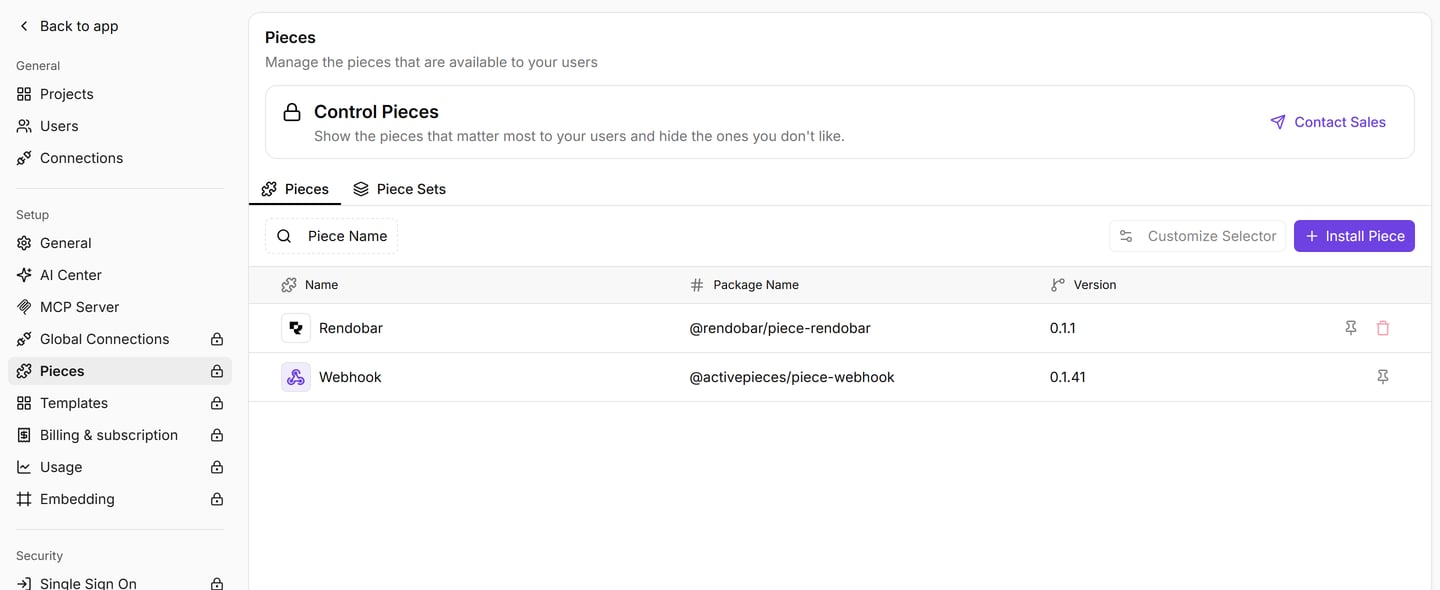
The Pieces page in the platform admin after an install. Rendobar is listed by its npm package name and version, and Install Piece at the top right adds the next one.
Add your API key
Add a Rendobar step to a flow and create a connection with your API key, which starts withrb_. The piece checks the key against your account when you save the connection.
Use an API key rather than an OAuth token. Finished Job registers a webhook on your account, and Rendobar refuses webhook management over OAuth. If you restrict the key’s scopes, keep webhooks:write for that trigger.
Run a job
Add Run a Media Job and pick a Job Type. The form below it is built from that job type’s live schema, so a new job type shows up without a piece update.- Input Media has one field per file the job reads.
ffmpegandffprobename their files inside the command, so they get a map from file name to URL instead. - Parameters are the job’s own settings. A job type with several models shows Variant first, and the fields change to match.
- Deliver To writes the output to buckets connected on the Storage page, optionally under a Delivery Folder or Path.
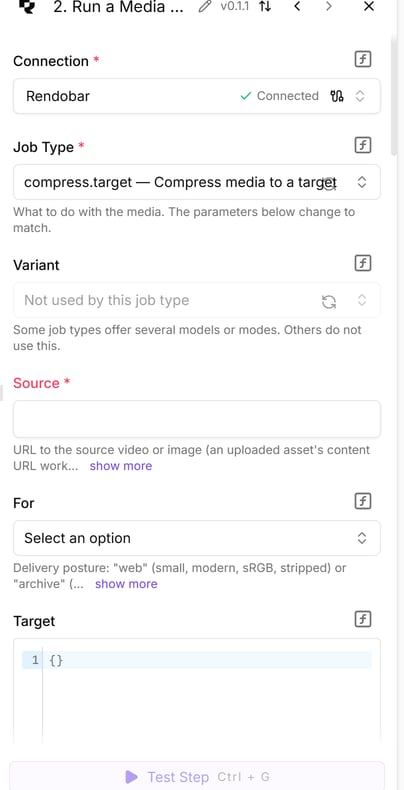
Run a Media Job with compress.target selected. Variant is disabled because this job type has one mode, and Source, For and Target come from the job type's schema.
url in a media field. The upload goes straight to storage through a presigned URL, so the bytes never pass through the API.
What comes out
Every job-shaped action and trigger returns the same flat row, so a table built on one step works with the others.cost_formatted can be null on a row read the moment a job completes, because billing settles a moment later. A later read carries it.
How do I wait for a long job?

Polling holds a worker and repeats status calls for the whole job. A waitpoint submits once, parks the flow, and resumes it when Rendobar calls back.
- Fail This Step if the Job Fails is on by default, so a failed job runs the flow’s error path. Turn it off to branch on
succeededinstead. - Idempotency Key is derived from the run, the step and the submission when left empty. An automatic retry then settles on the job it already created instead of billing a second one.
How do I start a flow when a job finishes?
Finished Job registers a webhook on your Rendobar account when the flow is turned on, and deletes it when the flow is turned off. Outcome picks which jobs start the flow:compress.target. The flow receives the same row Get Job returns, read fresh from the API. Each flow with this trigger uses one of the 10 webhook endpoints an organization can have.
Finished Job (Polling) does the same on a timer, for an Activepieces that Rendobar cannot reach.
Actions
Troubleshooting
Install Piece is not available
Install Piece is not available
The step polls instead of pausing
The step polls instead of pausing
AP_FRONTEND_URL. When that points at localhost or a private address, Rendobar cannot reach it, so the step polls. Set it to the platform’s public HTTPS address and restart Activepieces.Finished Job cannot be turned on
Finished Job cannot be turned on
webhooks:write scope is refused, and so is an OAuth token. If this Activepieces is not reachable from the internet, use Finished Job (Polling).Get Job reports that no job was given
Get Job reports that no job was given
{{step_1.id}} resolves to nothing when the step name is wrong, so pick the value again from the data selector.A large output file does not attach
A large output file does not attach
file_url to the next step, which most steps accept.See also
- Callbacks: the per-job URL the waitpoint listens on
- Storage connections: the buckets Deliver To writes to
- Package on npm: versions and release notes
- Source on GitHub: MIT licensed
ffmpeg, and run a command against a public video URL.